
(Download: ISO/IEC 17025 Accreditation in PDF by Medistri)
Medistri’s laboratory has been accredited to ISO/IEC 17025 by the Swiss Accreditation Service (SAS) since 2008. The standard is a familiar name in our industry, but what accreditation actually covers, how it is maintained, and why the way a scope is written makes a practical difference are less well known. Our 2026 scope extension will move four of our analytical techniques from a type B to a type C scope, so this is a good moment to explain all three.
From Guide 25 to ISO/IEC 17025:2017
The standard grew out of international efforts to make laboratory results trusted across borders. ILAC began as an international conference held in Copenhagen in October 1977, with the aim of facilitating trade by promoting the acceptance of accredited test and calibration results. ISO Guide 25, the forerunner of today’s standard, was published in 1978 and revised in 1982 and 1990. In Europe, laboratory accreditation was based on the regional standard EN 45001.
In December 1999, ISO/IEC 17025 replaced Guide 25 as a full international standard, and in Europe it superseded EN 45001 in 2000. The 2005 edition brought its management requirements into line with ISO 9001:2000. The current edition, ISO/IEC 17025:2017, was a substantial rewrite. Its structure now follows the other conformity assessment standards of the ISO/IEC 17000 series. It introduces risk-based thinking, gives impartiality and confidentiality their own clauses, and requires a clearly defined decision rule, agreed with the customer unless it is inherent in the specification, whenever a statement of conformity to a specification is requested. In Switzerland, it is published as SN EN ISO/IEC 17025:2018.
Accreditation Is Not Certification
ISO/IEC 17000:2020 defines accreditation as “third-party attestation related to a conformity assessment body, conveying formal demonstration of its competence, impartiality and consistent operation in performing specific conformity assessment activities.” Two words carry most of the weight: competence and specific.
Certification to ISO 9001 confirms that an organization runs a quality management system. On its own, it does not demonstrate that a laboratory’s results are technically valid, because ISO 9001 does not assess technical competence. ISO/IEC 17025 includes management system requirements consistent with the principles of ISO 9001, but its core is technical: personnel competence, facilities and environmental conditions, equipment, metrological traceability, selection and validation of methods, measurement uncertainty, quality control of results, and reporting.
Accreditation is also always tied to a defined scope. A test outside that scope may well be performed competently, but it cannot be reported as accredited.
One Family, Several Standards
ISO/IEC 17025 belongs to a family of standards used for accreditation, each written for a different kind of organization:
• ISO/IEC 17025: testing and calibration laboratories
• ISO 15189: medical laboratories
• ISO/IEC 17020: inspection bodies
• ISO/IEC 17065, ISO/IEC 17021-1 and ISO/IEC 17024: bodies certifying products, management systems and persons
• ISO/IEC 17043: proficiency testing providers
• ISO 17034: reference material producers
Good Laboratory Practice (GLP) is often mentioned in the same breath but works differently. It is not an accreditation. It is a compliance monitoring program run by national authorities under the OECD Principles of GLP, and it governs the conditions under which non-clinical health and environmental safety studies are planned, performed, monitored, recorded, archived and reported. The two systems complement each other: since May 2026, Medistri has also been enrolled in the Swiss GLP compliance monitoring program.
How Accreditation Works
In Switzerland, accreditation is granted by SAS, which is part of the State Secretariat for Economic Affairs (SECO). A laboratory applies for a defined scope, and an assessment team reviews its management system and assesses it on site. Assessors witness a representative selection of the accredited activities and of the staff who perform them, from planning and execution through to interpretation and reporting of results.
Accreditation is granted for a maximum of five years. During that period, SAS carries out regular surveillance assessments, and every element of the standard and every technical field in the scope must be checked at least once in each five-year cycle. Surveillance can also include the laboratory’s participation in proficiency tests and interlaboratory comparisons, and how it interprets the results. The accreditation must then be renewed through a reassessment. Medistri’s current accreditation runs from August 2023 to August 2028.
Why It Matters for Medical Device Manufacturers
When test data goes into a technical file, a reviewer needs to know whether it can be trusted. Accreditation answers a large part of that question in advance:
• Technically valid results. Validated methods, calibrated equipment with traceability to SI units, evaluated measurement uncertainty and ongoing quality control, all checked by an independent body.
• Impartiality. Risks to impartiality must be identified and managed, and confidentiality is an explicit requirement.
• Recognition beyond borders. Accreditation bodies that have signed the international mutual recognition arrangements recognize each other’s accreditations, and each signatory is re-evaluated by its peers every four years. The ILAC Mutual Recognition Arrangement, signed in 2000 by 36 accreditation bodies from 28 economies, built this network for laboratories. Since 1 January 2026, ILAC and IAF have operated as a single organization, Global Accreditation Cooperation Incorporated, and accreditations issued under the previous arrangements continue to be recognized. SAS is a member of both the European co-operation for Accreditation (EA) and Global Accreditation Cooperation.
• Simpler supplier qualification. Under ISO 13485, manufacturers have to evaluate and select their suppliers. A published scope gives objective evidence of competence for the tests it covers.
Fixed or Flexible: Scope Types A, B and C
An accreditation is only as useful as its scope. SAS describes the scopes of testing laboratories in three types, defined in SAS document 741. The competence expected is the same for all three. What differs is how much the laboratory may change without a prior SAS assessment, and where SAS puts its focus during surveillance.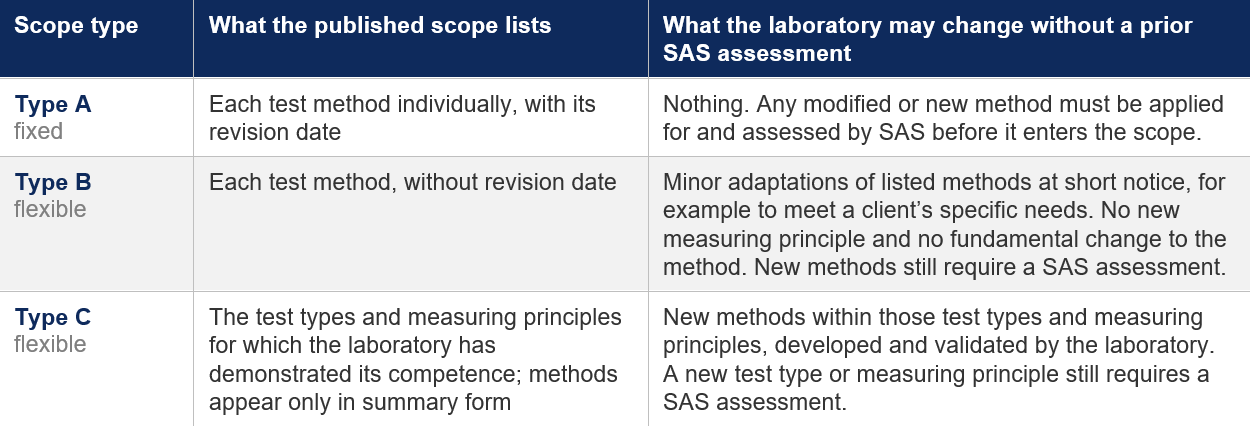
Flexibility comes with obligations. Laboratories with a type B or C scope must have documented procedures and responsibilities for assessing risks and for characterizing and validating new or modified methods, and they must follow the European requirements for flexible scopes (EA-2/15 M). They keep a controlled list of every method within the accredited scope. For type C, this list records, for each method, the product or matrix, test type and measuring principle, measured characteristic, type of procedure (commercial, standard or in-house), internal instruction, references, version and release date, and SAS recommends that it also shows the internal and external quality controls applied. New and revised methods are one of the focuses of SAS surveillance.
Our 2026 Extension: Type C for Chromatography, Spectroscopy and Gravimetry
Our 2026 extension will move four measuring principles to a type C scope:
• Gas chromatography with flame ionization detection (GC-FID)
• Gas chromatography–mass spectrometry (GC-MS)
• UV/VIS spectrometry
• Gravimetry
Gas chromatography, spectrometry and gravimetry are already part of our accredited scope as type B, with each method listed individually: for example, ethylene oxide and ethylene chlorohydrin residues by GC-FID, phthalates, bisphenols, VOC and SVOC by GC-MS, protein assay by spectrometry, and global migration by gravimetry. Under type C, the scope for these techniques will be defined by the measuring principle and will cover products and extracts, including liquids, powders, and single-use or multiple-use medical devices made of different materials, analyzed with internal methods based on commercial or standard methods. The rest of our scope remains type B: microbiological methods, microscopy, cell culture methods, FTIR, general chemistry and physical methods, which include our sterile barrier packaging tests.
What Type C Changes for You
Chemical testing for medical devices is rarely off the shelf. A residual solvent, a crosslinker residue, a process additive or a specific extractable often calls for a method built around one material, one device and one extraction. Our validated HS-GC-FID method for residual IPA and our GC-MS analysis of residual BDDE in hyaluronic acid fillers are examples of this kind of work.
Today, under our type B scope, each new method of this kind needs a SAS assessment before its results can be reported under accreditation. Under type C, once a new GC-FID, GC-MS, UV/VIS or gravimetric method within our accredited test types and product groups has been developed and validated under our documented procedures and released on our method list, we will be able to report its results as accredited without waiting for a separate SAS assessment. For you, that means accredited results for methods developed specifically for your product, without an additional assessment step.
What does not change is the standard of evidence. Every method is validated before release, new and revised methods remain one of the focuses of SAS surveillance, and a new test type or measuring principle would still have to be assessed before entering our scope. Our detailed list of accredited methods is available on request.
Medistri’s Accreditation At A Glance
• Accreditation number: STS 0504, Swiss Accreditation Service (SAS)
• Standard: ISO/IEC 17025:2017 (Swiss edition SN EN ISO/IEC 17025:2018)
• Accredited since: August 2008
• Current accreditation: August 2023 to August 2028
• Scope: microbiological, chemical, biological and physical analysis of medical devices, pharmaceuticals and environments
• Type C (with the 2026 extension): GC-FID, GC-MS, UV/VIS spectrometry, gravimetry
• Type B: microbiological methods, microscopy, cell culture methods, FTIR, general chemistry, physical methods
How We Can Support You
If your project needs a method that does not exist yet, whether for a specific extractable, a process residue or a new material, talk to us early. We can tell you which measuring principle it falls under, what validation it will need, and how it fits within our accredited scope.
Learn more about our Laboratory on our website here or contact our dedicated team at lab@medistri.swiss.
— The Medistri Team
#Medistri
Medistri is Europe's leading independent contract sterilization company, founded in 2006 and headquartered in the heart of Switzerland. We are a global player providing essential infrastructure that powers healthcare innovation worldwide.
We serve customers of all sizes, from startups, university projects, and research institutes to Fortune 500 corporations, across Medical Devices, Pharmaceutical Packaging, and Biotech.
Medistri supports products at every stage of the lifecycle: pre-clinical development, go-to-market, and full industrialization.
Our fully integrated, end-to-end in-house solution allows our customers to focus on what matters most: engineering, innovation, and development, while we manage the critical back-end processes.
Our synchronized departments work together to provide a complete stack of services:
- Contract Sterilization & Validation Services
- Contract Laboratory Services
- Contract Manufacturing Services
- Logistics Services
- Consulting Services
We help you accelerate time-to-market, reduce barriers to scale, and deliver safer, more sustainable healthcare solutions to patients around the world.