(Download: Environmental Monitoring for Medical Device Manufacturers in PDF by Medistri)
Medical devices are manufactured, assembled, and packaged in environments where contamination, whether particulate, microbiological, or chemical can directly compromise product safety. Environmental monitoring is the systematic process of measuring and documenting the conditions in these environments, providing manufacturers with the evidence they need to demonstrate that their production areas are under control.
At Medistri, we perform environmental monitoring across three complementary domains:
- Airborne Particle Counting
- Microbiological Assessment of Air, Surfaces, and Personnel
- Chemical Air Monitoring for Volatile Compounds including EO.
This article explains why each of these domains matters, how they relate to one another, and how Medistri supports manufacturers not only with routine monitoring but also with investigation and remediation when results fall outside limits.
Why Environmental Monitoring Matters
Regulatory frameworks, including the EU Medical Device Regulation (MDR), EU GMP Annex 1, ISO 14644, and EN 17141, require manufacturers to demonstrate that their production environments meet defined cleanliness standards. But beyond the regulatory obligation, the scientific rationale is straightforward: the cleaner the environment in which a device is manufactured, the lower the risk that contaminants will reach the patient.
For products that will be sterilized, the microbiological contamination of the device before sterilization, the bioburden, is a critical factor. A sterilization process is validated against a defined bioburden level. If the manufacturing environment allows that level to drift upwards undetected, the sterility assurance level of the final product is compromised. Environmental monitoring is the tool that catches this drift early, before it becomes a product safety issue.
Particles and Microorganisms: Why Both Must Be Monitored
Airborne particles and microbiological contamination are closely linked. Microorganisms in cleanroom air do not typically float freely, they are carried on particles. Skin cells shed by operators, fibers from garments, and dust from materials all act as vehicles for bacteria and fungi. The larger the particle, the more likely it is to carry viable microorganisms. This is why cleanroom classification under ISO 14644-1 focuses on particle counts at specific size thresholds, typically 0.5 µm and 5.0 µm.
Monitoring airborne particles tells you whether the filtration and ventilation systems are functioning as expected. If particle counts rise, it is an early indicator that something has changed, a filter may be degrading, a door seal may be failing, or operator behavior may have shifted. But particle counts alone do not tell you whether living organisms are present. That requires microbiological sampling.
This is why a comprehensive environmental monitoring program always combines both: particle monitoring to verify the physical performance of the controlled environment, and microbiological monitoring to verify that microbial contamination remains within acceptable limits. The two datasets together give a complete picture, and when read alongside one another, they can point directly to the source and mechanism of a contamination event.
Airborne Particle Monitoring — ISO 14644-1
Particle monitoring classifies and verifies cleanroom areas against ISO 14644-1 requirements. At Medistri, airborne particle counts are performed at defined sampling points, measuring concentrations at 0.5 µm and 5.0 µm. Results are compared against the classification limits for the area, from ISO 5 (laminar airflow workstations) through ISO 7 (cleanrooms) to ISO 8 (controlled environments). Alert and action limits are established for each monitoring point, so that a deviation is flagged well before it reaches the classification threshold.
Routine particle monitoring is performed every three months. The frequency can be increased in response to deviations, facility changes, or specific customer requirements. Unannounced checks may also be performed.
Microbiological Monitoring - EN 17141 & EU GMP Annex 1
Biocontamination control in cleanrooms is governed by EN 17141, which replaced ISO 14698-1 and ISO 14698-2 and establishes the requirements for setting up, demonstrating, and maintaining microbiological control in controlled environments. Since EN 17141 does not itself define numerical microbiological limits, Medistri applies the values from the European Guide to Good Manufacturing Practice (EU GMP Annex 1), which sets maximum acceptable levels across Grades A through D for airborne contamination, surface contamination, and personnel contamination.
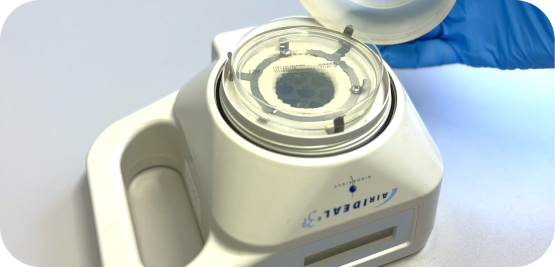
Airborne microbiological contamination is assessed using active air sampling onto culture media. Plates are incubated and read over five days, with results expressed in colony-forming units per cubic meter (cfu/m³). Surface contamination is assessed using contact plates applied directly to critical surfaces, with results expressed in cfu/plate. Personnel monitoring, typically fingerprint and elbow sampling, evaluates operator hygiene practices and is recommended every six months.
Together with particle counts, microbiological data allow manufacturers to confirm that their cleaning protocols are effective, that personnel gowning procedures are adequate, and that the overall level of microbial contamination in the production environment remains well within the limits required for the products being manufactured.
Chemical Air Monitoring - EO Across the Supply Chain
EO remains essential for sterilizing heat- and moisture-sensitive medical devices. But EO is classified as a probable carcinogen and mutagen, and regulatory expectations around occupational and environmental exposure are tightening across all major jurisdictions. For manufacturers, it is no longer sufficient to demonstrate that EO residuals on the device itself comply with ISO 10993-7. Regulators and supply chain partners increasingly expect documented evidence that EO levels are controlled at every stage of the handling chain, from the sterilized product, through its packaging and pallet, to warehouse storage and transport.
Passive diffusion badges are a simple and effective tool for generating this evidence. They can be deployed in two complementary ways. First, badges worn by operators during production provide a direct measurement of personal occupational exposure, compared against regulatory limits such as the Swiss SUVA VME of 1 ppm. Second, badges placed inside sterilized loads, within boxes, on pallets, or inside transport containers, measure the residual EO concentration in the air that warehouse and logistics personnel will encounter when they open, handle, or transport the product. This second use case is becoming increasingly important as downstream handlers, distributors, and end users demand documented assurance that EO risks are managed throughout the supply chain, not only at the point of sterilization.
Badge desorption and quantification of both EO and 2-chloroethanol (ECH) are performed in-house at Medistri’s laboratory by Headspace Gas Chromatography with Flame Ionization Detection (HS-GC-FID), in accordance with ISO 16200-2 and ISO/IEC 17025. The same approach can be applied to other volatile compounds frequently present in healthcare and pharmaceutical environments, including isopropanol (IPA), ethanol, acetone, toluene, and methyl ethyl ketone (MEK).
Looking ahead, Medistri is also developing capabilities in thermal desorption coupled with sorbent tube sampling, which will enable more dynamic, broader-spectrum chemical air analysis, extending our monitoring portfolio beyond the current passive badge approach to cover a wider range of volatile and semi-volatile compounds with higher sensitivity and time-resolved data.
For a detailed overview of EO badge testing and in-package headspace checks, see our dedicated blog post Monitoring EO in Ambient Air: Badge Testing & In-Package Safety Checks (October 2025).
When Results Fall Outside Limits: Investigation and Remediation Support
Monitoring is only valuable if it leads to action. When environmental monitoring results exceed alert or action limits, the immediate question is: what happened, and what needs to change? At Medistri, we do not simply report results and leave the manufacturer to interpret them. We actively support investigation and remediation.
When microbiological counts are elevated, identifying the organisms involved is often the fastest route to understanding the source of contamination. Medistri offers microbial identification and typing services that can trace a contamination event back to its origin, whether that is a specific operator, a cleaning process gap, a raw material, or an environmental source such as water or air handling systems. Knowing not just that contamination occurred, but what organism is responsible and where it likely came from, allows manufacturers to target corrective actions precisely rather than applying broad, disruptive measures.
We understand that an out-of-specification environmental monitoring result can have immediate consequences for production release. Our team is structured to respond quickly, providing rapid turnaround on identification work, supporting root-cause analysis, and helping manufacturers document the investigation and corrective actions in a way that satisfies auditors and notified bodies.
A Complete Environmental Monitoring Partner
Medistri’s environmental monitoring capabilities can also be extended to include airborne endotoxin assessment for manufacturers who require documented control of pyrogenic contamination in production environments.
By combining routine monitoring, investigation support, and microbial identification under one roof, Medistri provides manufacturers with a single partner for the full lifecycle of environmental monitoring, from initial cleanroom qualification through routine surveillance, seasonal chemical exposure campaigns, and rapid-response investigation when something goes wrong. The result is cleaner production environments, stronger documentation, and faster resolution when issues arise.
Learn more about our Laboratory. To ensure your products meet the highest quality and safety standards, contact our dedicated team at contact@medistri.com.
— The Medistri Team
#Medistri
Medistri is Europe's leading independent contract sterilization company, founded in 2006 and headquartered in the heart of Switzerland. We are a global player providing essential infrastructure that powers healthcare innovation worldwide.
We serve customers of all sizes, from startups, university projects, and research institutes to Fortune 500 corporations, across Medical Devices, Pharmaceutical Packaging, and Biotech.
Medistri supports products at every stage of the lifecycle: pre-clinical development, go-to-market, and full industrialization.
Our fully integrated, end-to-end in-house solution allows our customers to focus on what matters most: engineering, innovation, and development, while we manage the critical back-end processes.
Our synchronized departments work together to provide a complete stack of services:
- Contract Sterilization & Validation Services
- Contract Laboratory Services
- Contract Manufacturing Services
- Logistics Services
- Consulting Services
We help you accelerate time-to-market, reduce barriers to scale, and deliver safer, more sustainable healthcare solutions to patients around the world.
Medistri Solutions for Product in Industrialization Phase
In the industrialisation phase, reliability, scalability, and operational excellence become paramount to sustain high-volume production, maintain consistent quality, and ensure uninterrupted supply to the market.
Medistri serves as your long-term, fully integrated infrastructure partner, delivering a robust portfolio of in-house services optimised for routine commercial manufacturing and ongoing compliance.
Our solutions include routine sterilization services, validation review and maintenance, issuance of sterilization CO₂ certificates, routine laboratory services, environmental monitoring, kit packing services, post-sterilization storage, picking, packing, and shipping, as well as dedicated audit support services.
By controlling the entire production and quality assurance chain within our facilities, Medistri eliminates external dependencies, guarantees process consistency and full traceability, minimises downtime risks, and supports seamless scaling.
allowing your team to focus on optimising product performance, expanding market reach, and driving long-term commercial success with confidence.
Frequently Asked Questions
1. What is environmental monitoring in healthcare manufacturing?
Environmental monitoring is the process of measuring and documenting air, surfaces, and personnel conditions in controlled environments. It provides evidence that contamination risks are managed and that production areas remain within defined cleanliness limits.
2. Why are both particles and microorganisms monitored?
Particles indicate how well the cleanroom environment is controlled, while microorganisms confirm the presence of viable contamination. Monitoring both provides a complete understanding of contamination risks and helps identify potential sources of deviation.
3. How often should environmental monitoring be performed?
Monitoring frequency depends on regulatory requirements and risk levels, but particle monitoring is typically performed every three months, with microbiological checks performed regularly based on area classification. Additional monitoring may be required after deviations, changes, or specific operational needs.
4. How is chemical air monitoring performed in practice?
Chemical monitoring is commonly performed using passive badges placed on operators or within product environments. These badges absorb volatile compounds over time and are later analyzed to quantify exposure levels and verify compliance with safety limits.
5. How does Medistri support environmental monitoring and deviation management?
Medistri combines routine monitoring with investigation and remediation support when results exceed limits. This includes microbial identification, root-cause analysis, and guidance on corrective actions to help restore control and ensure compliance.